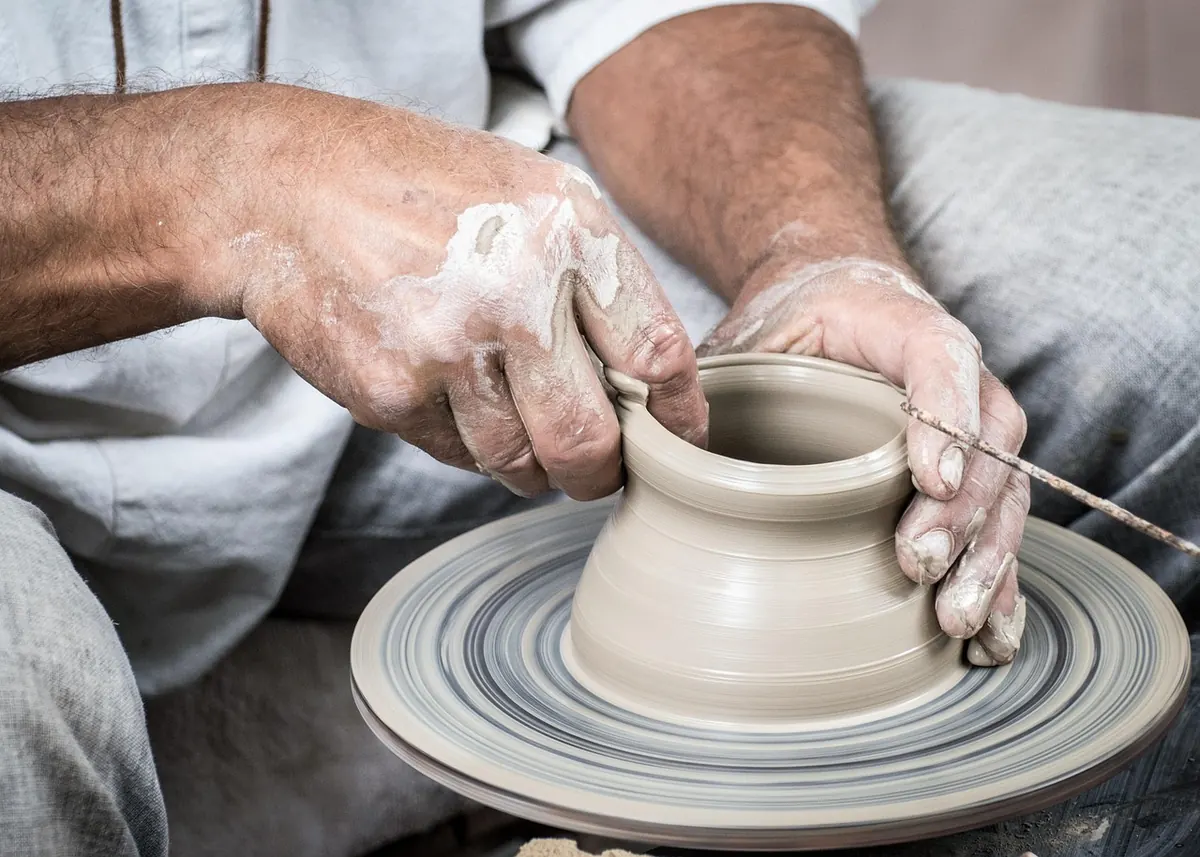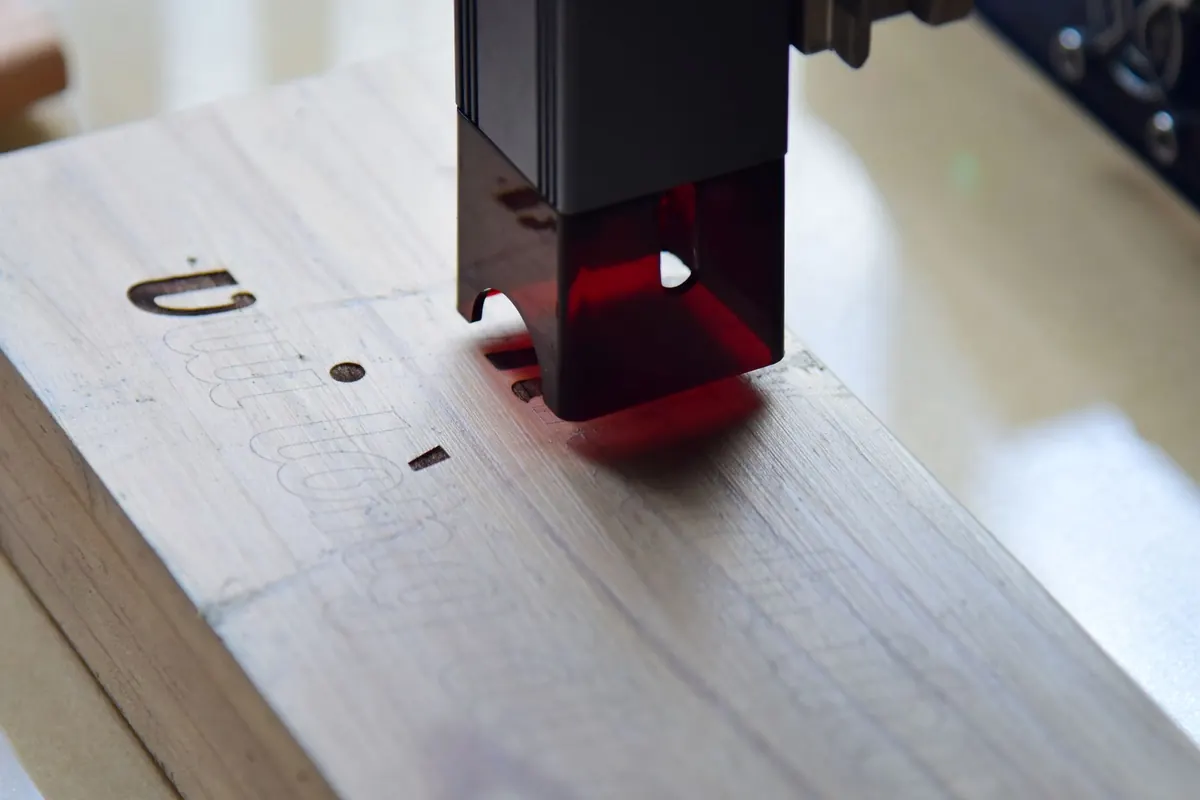
A name on a wooden chopping board. A date inside a silver locket. A child's drawing on a ceramic mug. All three are personalisation, but the mark is made in completely different ways, and the difference shows the moment the gift comes out of the box. One method cuts into the surface; the other lays colour on top of it. That single fact shapes how a gift looks on arrival, how it ages, what it costs, and how long you wait for it. Before you tick "add engraving" at checkout, it helps to know which method suits the object in your basket — and the person who will receive it.
The core difference: removing material versus adding it
Engraving takes something away. A laser burns or vaporises a shallow layer of the surface; a rotating diamond or carbide tip cuts a fine groove into metal, glass or stone; sandblasting etches through a rubber stencil. In every case, the mark is part of the object. You can feel it with a fingernail.
Printing adds something. UV printing sprays cured ink directly onto a flat surface. Sublimation uses heat to turn special inks into gas that bonds with a polymer coating, which is how most full-colour mugs and phone cases are made. Pad printing transfers ink from a silicone pad onto curved items such as pens and bottle openers. Screen printing pushes ink through a mesh, and foil stamping presses a thin metallic layer onto leather or card.
Neither is better in general. They fail in different places, and they shine in different places.
Appearance: depth, contrast and the texture of the gift
On stainless steel and silver, engraving produces a mark that changes tone as you turn the object in the light — subtle, understated, and very hard to mistake for a sticker. On wood, a laser leaves a toasted brown line whose darkness depends on the grain and the oils in the board; some woods engrave crisply, others blur at the edges. On glass, engraving shows as a frosted, milky white that reads beautifully against a dark table.
Printing wins wherever colour matters. A photo of a couple on a slate coaster, a watercolour pattern around a lunchbox, a logo in three brand colours: none of that is possible with a laser. Modern UV printing holds fine detail and gradients well on flat, rigid surfaces.
The trap to watch for
Engraving a photograph onto metal or wood is possible, but it is not a photocopy. It is a tonal rendering, usually a dot pattern or a greyscale burn, and it depends heavily on your source image. A photo taken in dim indoor light will engrave as mud. If you want a portrait, choose a sharp, brightly lit image with a simple background, and ask for a preview before production. Reputable studios will send one; if a shop refuses, that tells you something.
Durability: what survives a dishwasher, a keyring and a decade
Engraved marks do not peel, fade or wash off, because there is nothing sitting on the surface to lose. A engraved silver bangle can be worn daily for years; the letters may soften slightly at the edges but they will still be there. Engraving on a wooden board survives scrubbing, though the burned area can darken unevenly over time as the wood takes on oil.
Printing durability varies far more, and it depends on the substrate and the finish:
- UV print on rigid flat surfaces (slate, metal plates, acrylic, bamboo) is tough and handles normal handling well.
- Sublimated mugs and textiles are bonded into the material and generally hold up, but dishwasher cycles and abrasive sponges shorten their life. Hand washing is the safer habit.
- Vinyl decals look sharp on day one, then lift at the edges on curved or flexed surfaces, especially after repeated washing.
- Foil stamping on leather wears at high-friction points — the corner of a wallet that rubs against a pocket, the spine of a notebook.
If the gift will be used hard — a keyring, a hip flask, a kitchen board, a piece of jewellery — engraving is usually the more forgiving choice. If it will be looked at more than handled, printing gives you far more design freedom.
Cost and lead time: where the money and the days go
For a single item, engraving is often the simpler and sometimes the cheaper route, because no printing plates, screens or colour proofs are needed. The file goes to the machine and the machine runs. On a metal tag or a wooden box, one-off engraving can be done in minutes.
Printing carries setup costs — artwork preparation, colour matching, sometimes a physical proof — that only make sense once you order several identical pieces. Order one printed mug and you pay for the setup; order thirty and the setup spreads thin. That is why printing tends to pull ahead on price for bulk gifts such as wedding favours, team presents or branded corporate sets.
Lead time follows the same logic. In-house engraving is frequently a same-day or next-day service. Printed work may need a proof approval stage, drying or curing time, and sometimes an outside supplier, so allow extra days. If your gift has a hard deadline — a birthday on Saturday, a wedding on the 14th — build in a buffer and ask the studio directly rather than trusting the checkout estimate.
Best-use cases: matching the method to the gift
- Jewellery, watches, cufflinks, hip flasks: engraving. Fine detail, permanent, no colour needed.
- Wooden boards, boxes, pencils, coasters, chopping blocks: engraving, ideally laser, for a warm rustic look.
- Glassware, mirrors, perfume bottles, decanters: engraving or sandblasting for a frosted finish.
- Photo gifts, children's drawings, colourful designs: printing, without question.
- Mugs, phone cases, aprons, tote bags: sublimation or UV printing, where colour and full coverage are the point.
- Leather wallets, luggage tags, journals: engraving or foil stamping, depending on whether you want a debossed mark or a metallic one.
- Large batches of identical items: printing, once setup costs are spread across the run.
- A single item needed fast: engraving, if the material allows it.
Questions to ask before you order
- Can I see a digital preview, and can I approve it before you produce the item?
- Is the personalisation permanent, or will it wear with washing and handling?
- What file quality do you need — vector artwork, or is a high-resolution photo acceptable?
- Does the material limit what I can have? Very small text fills in on wood; very thin lines disappear on fabric.
- What is the realistic dispatch date, not just the shipping estimate?
- What happens if a name is misspelled — whose proof is the final one?
A short decision path
Start with the material, because it sets the limits. Metal, glass, stone, wood and leather can be engraved; plastics and coated ceramics open the door to vivid printing. Then ask what the gift has to do. If it needs to survive daily use and look dignified in ten years, choose engraving. If it needs to carry a face, a photo, a palette or a drawing, choose printing and accept that you will need to look after it a little more carefully.
Finally, weigh your deadline against the method. A beautifully engraved item ordered too late is still a gift that misses the birthday. Give yourself the extra week, ask the studio for a preview, and read the spelling twice — the personalisation is the part nobody can quietly exchange.
Photo: Sóc Năng Động / Pexels